
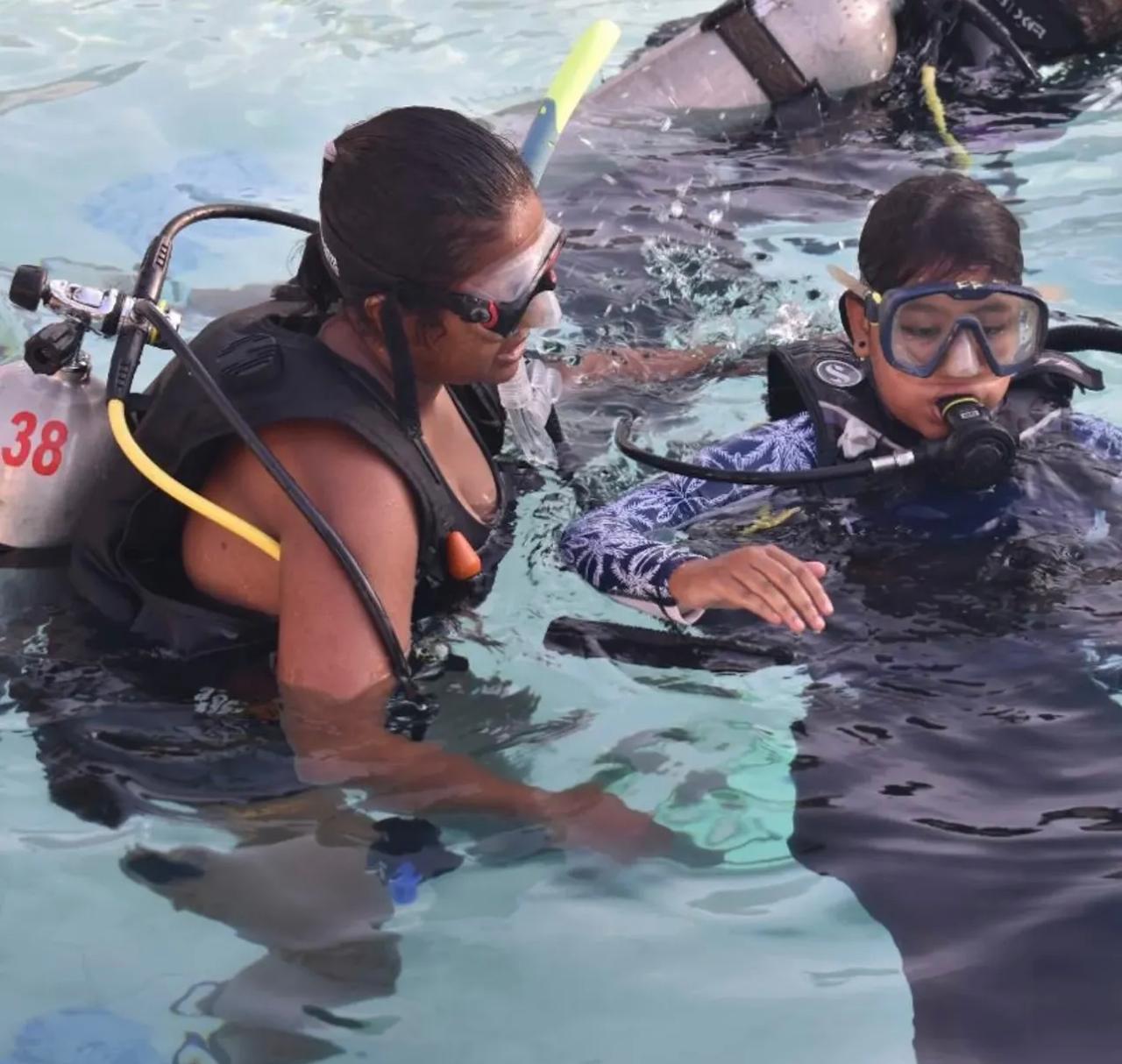
Action March: Promoting Gender Equity for Our Ocean
-
Tanya Satish
- April 8, 2026
- No Comments
Women, Accessibility, and the Future of Ocean Tourism
March is often associated with renewal—new seasons, new ideas, and renewed commitments. It is also the month that celebrates International Women’s Day, a global reminder that progress toward gender equality requires constant action.
Before speaking about oceans and tourism, it is worth clarifying an important idea: accessibility is not only about physical infrastructure. At its core, accessibility means ensuring that everyone can participate fully and safely, regardless of gender, ability, age, or background. In this sense, accessibility naturally overlaps with gender equality—because a truly accessible world must remove barriers that prevent women and girls from participating in education, leadership, travel, and environmental decision-making.
When we apply this thinking to the ocean, something powerful emerges: an inclusive ocean is a stronger ocean.
Why Gender Equity Matters for the Ocean
Across the world, women play vital roles in coastal communities, marine conservation, fisheries, tourism, and environmental education. Yet historically, their contributions have often been invisible or undervalued.
The United Nations has repeatedly highlighted that empowering women is essential for protecting marine ecosystems and achieving sustainable development. According to UN reports, women are still underrepresented in marine science, ocean governance, and maritime industries—even though their knowledge and community leadership are critical for sustainable ocean management.
As UN Secretary-General António Guterres once noted:
“Gender equality is a question of power, justice and rights. It is also essential for sustainable development.”
When applied to ocean conservation, this statement becomes especially meaningful. Women often bring community-based knowledge, collaborative leadership styles, and long-term environmental perspectives that are essential for protecting fragile marine ecosystems.
The ocean itself sustains billions of people. It regulates climate, provides food security, and supports livelihoods for coastal communities worldwide. But protecting it requires diverse voices at the decision-making table.
The Overlooked Link Between Accessibility and Gender
Accessibility is frequently discussed in the context of disability—and rightly so. According to the World Health Organization, more than 1.3 billion people globally live with significant disabilities, representing about one in six people worldwide.
But accessibility also intersects deeply with gender. Women and girls with disabilities, for example, often face double barriers—social barriers related to gender and structural barriers related to accessibility.
In ocean tourism and marine recreation, these barriers can be particularly visible. Adventure activities such as diving, sailing, or marine research expeditions have historically been dominated by men and designed primarily for able-bodied participants.
Yet the ocean does not belong to one group.
True accessibility means creating opportunities for women, persons with disabilities, seniors, and young girls to explore and connect with marine environments safely and confidently.
When tourism operators, dive centers, and marine institutions design inclusive programs—from adaptive diving training to women-led marine education—they help reshape the narrative of who belongs in the ocean space.
Women in Ocean Science and Conservation
Despite progress in recent decades, women remain underrepresented in ocean science and leadership roles. Globally, women account for less than half of researchers in many marine science fields, and their presence in maritime industries remains limited.
Yet some of the most inspiring ocean initiatives today are led by women—marine biologists, conservationists, educators, and divers who are redefining how we interact with the ocean.
The United Nations has emphasized that gender equality is central to achieving Sustainable Development Goal 14 – Life Below Water and Sustainable Development Goal 5 – Gender Equality.
As former UN Environment Executive Director Inger Andersen highlighted in discussions on environmental leadership:
“Women are powerful agents of change for the environment, yet their voices are too often missing from decision-making spaces.”
In coastal communities around the world, women are often the primary educators for younger generations, passing on knowledge about ecosystems, tides, fisheries, and conservation practices. When these voices are amplified in policy and tourism planning, ocean management becomes more inclusive and resilient.
Ocean Tourism as a Platform for Inclusion
Ocean tourism—diving, snorkeling, marine wildlife experiences, and coastal exploration—is one of the fastest-growing sectors of the global travel industry. But it is also an area where inclusion can still improve dramatically.
Historically, the image of an ocean explorer has been shaped by narrow stereotypes: male scientists, professional divers, or elite adventurers. But today’s ocean community is far more diverse.
Women are leading dive expeditions, managing marine protected areas, teaching ocean literacy, and creating sustainable tourism models that protect fragile ecosystems.
Accessible ocean tourism builds on this momentum. It encourages tourism operators to think beyond traditional structures and design experiences that welcome:
• Women traveling independently
• Women scientists and divers
• Families with children
• Travelers with disabilities
• Seniors and first-time ocean explorers
When these groups are included, tourism becomes more than recreation—it becomes education and stewardship.
Ocean Literacy and Women as Educators
Another powerful dimension of gender equity in ocean spaces is education.
Women have long played central roles in environmental education, community outreach, and youth mentorship. Through ocean literacy initiatives, women educators help bridge the gap between science and society.
The ocean produces around half of the oxygen we breathe and absorbs significant amounts of carbon dioxide, making it one of the most important regulators of Earth’s climate. The United Nations has repeatedly emphasized that public understanding of the ocean is essential for protecting it.
When girls and young women are encouraged to explore marine science, diving, conservation, and coastal stewardship, they become the next generation of ocean leaders.
In many communities, simply seeing women divers, marine scientists, and ocean educators can inspire young girls to imagine themselves in similar roles.
Representation matters.
Rethinking Ocean Spaces
As we reflect during Women’s Month, it is worth asking a simple but important question:
Who feels welcome in ocean spaces today?
For some, the answer is obvious. For others—especially women from marginalized communities or persons with disabilities—the answer may still be uncertain.
Building inclusive ocean spaces requires intentional effort. It means designing dive programs that train instructors in adaptive techniques. It means creating safe environments for women travelers and divers. It means supporting women in leadership roles within marine tourism, research, and conservation.
Most importantly, it means recognizing that equity strengthens environmental protection.
A Personal Reflection
Every time I enter the ocean, I am reminded how equalizing the underwater world can be. In water, gravity disappears. Movement becomes fluid. The boundaries that divide us on land begin to fade.
The ocean reminds us that humanity shares one planet and one interconnected ecosystem.
If we want to protect that ecosystem, we must ensure that everyone has a place within it.
Women’s leadership, accessible tourism, and ocean literacy are not separate conversations—they are deeply connected. Together, they help build a future where the ocean is not only protected, but also experienced and valued by people from every walk of life.
This Women’s Month, promoting gender equity for our ocean means something very simple:
Opening the ocean to everyone—and ensuring that women are leading the way.